 中文版
中文版  Spain
Spain  Arabic
 Russian
 Korean
 Thai
Thai vietnamese
 Persian
 Deutsch
 Türkce
 日本語
日本語
Corrosion Resistance Test Methods for Stainless Steel Butterfly Valves
Introduction
In chemical, desalination, and offshore services, stainless steel butterfly valves face chlorides, acids, and cyclic humidity that can trigger pitting, crevice, and stress-corrosion cracking. A structured test plan—spanning material coupons, valve components, and full-valve assemblies—helps verify durability and choose the right grade (e.g., 316/316L, 2205 duplex, 2507 super duplex) and seat/liner options (PTFE, EPDM, FKM).
1) Standards to Reference (Quick Map)
-
API 609 – Butterfly valve design/scope (context for products).
-
API 598 / ISO 5208 – Pressure & seat tests (not corrosion, but run alongside).
-
ISO 9227 / ASTM B117 – Neutral salt spray (NSS) for general corrosion screening.
-
ASTM G85 – Modified salt fog (cyclic SO₂, acetic acid, seawater spray).
-
ASTM G48 (A/B) – Pitting/crevice corrosion in FeCl₃ for stainless steels.
-
ASTM G150 – Critical pitting temperature (CPT), electrochemical.
-
ASTM A262 (A–E) – Intergranular corrosion (IGC) for austenitic stainless.
-
ASTM G59 / G102, G61 – Electrochemical corrosion rate & polarization tests.
-
ASTM G31 – Immersion corrosion rate (liquid chemical exposure).
-
ASTM G71 – Galvanic corrosion (dissimilar metal coupling).
-
ISO 15156 / NACE MR0175 – Materials for H₂S (sour) service.
-
NACE TM0177 / TM0284 – SSC/HIC testing for sour environments.
-
ASTM D543 – Chemical resistance of non-metallics (PTFE, elastomer seats/liners).
2) Test Plan Structure (Three Levels)
Level A — Material Qualification (Coupons)
Purpose: rank alloys/heat treatments before building valves.
-
Salt Spray (ISO 9227 / ASTM B117): 240–1000 h exposure; assess rust, pitting, mass loss.
-
Pitting/Crevice (ASTM G48 A/B): fixed time/temperature in FeCl₃; inspect pit depth/area.
-
CPT (ASTM G150): determine temperature at which stable pitting starts.
-
IGC (ASTM A262): Practices C/E for sensitization in weld HAZs of 304/316.
-
Electrochemical Rate (ASTM G59/G102): corrosion rate in service-mimicking media.
-
Sour Service (NACE TM0177/TM0284): if H₂S is present.
Level B — Component Tests (Disc, Shaft, Body, Fasteners)
Purpose: evaluate galvanic couples, welds, and surface finishes.
-
Galvanic (ASTM G71): pair disc (e.g., 316) with shaft (e.g., 17-4PH) in chloride brine; measure current/potential.
-
Crevice Rigs (ASTM G48 B) on disc edges and under seat retainers.
-
Coating/Passivation Checks: verify nitric/citric passivation effectiveness by salt spray snapshots (24–96 h).
Level C — Full-Valve Environmental & Functional
Purpose: prove real-world survivability.
-
Cyclic Corrosion (ASTM G85 / ISO 16701-type): wet/dry/condense cycles with chlorides; function test periodically.
-
Immersion (ASTM G31) in actual process liquor (e.g., NaCl/NaOCl, low-pH acid, solvent).
-
Elastomer/Seat Compatibility (ASTM D543): hardness, mass, and dimensional change after immersion.
-
Post-Exposure Operation: torque curve, leak tightness (API 598/ISO 5208), stem sealing check.
3) Step-by-Step: Core Methods & How to Run Them
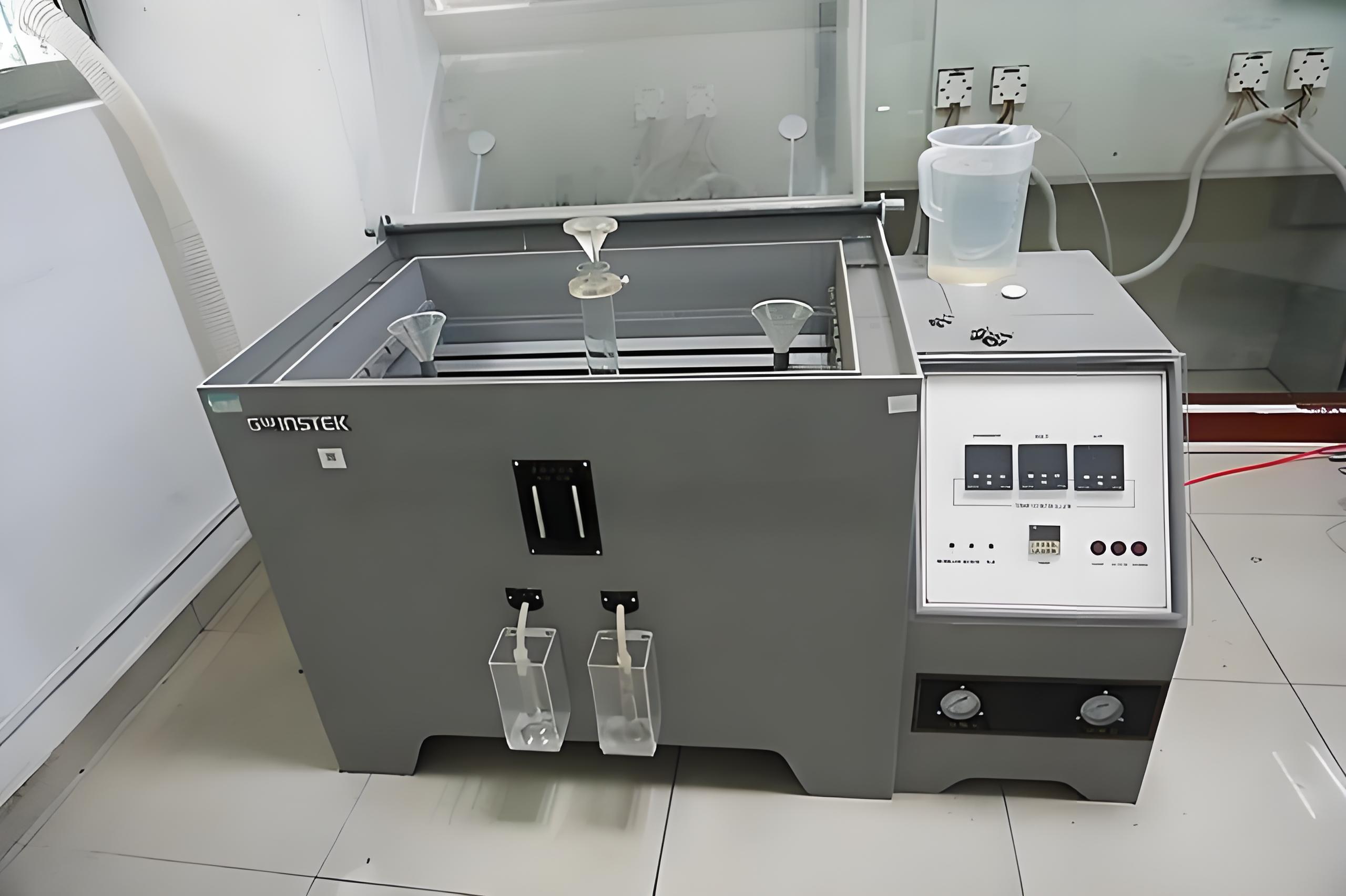
A. Neutral Salt Spray (ISO 9227 / ASTM B117)
-
Prep: clean, passivate, and label specimens (coupons + small components).
-
Conditions: 5% NaCl, pH 6.5–7.2, 35 °C, continuous fog.
-
Duration: 240 h minimum for screening; extend for harsher benchmarking.
-
Evaluation: visual rating, pit count, mass loss (mg/cm²), photos.
Use for: quick comparative screening, finish/passivation QC.
B. Modified Salt Fog (ASTM G85)
-
Select cabinet cycles (e.g., A3 seawater acidified test, A5 SO₂ cycles).
-
Better simulates coastal/offshore atmospheres than B117 alone.
Use for: marine/coastal chemical plants, splash zones.
C. Pitting & Crevice (ASTM G48 A/B)
-
Medium: FeCl₃ solution per standard.
-
Run: expose at specified T (e.g., 22–50 °C) for 24–72 h.
-
Assess: maximum pit depth, area; crevice tracks under washers/crevice formers.
Use for: chloride-rich service qualification and material ranking.
D. Critical Pitting Temperature – CPT (ASTM G150)
-
Ramp temperature in chloride solution while monitoring current; record CPT.
Use for: selecting between 316L vs 2205 vs 2507 for aggressive brines.
E. Intergranular Corrosion – IGC (ASTM A262)
-
Practices C (Huey), E (Strauss) for austenitic grades and weld HAZs.
Use for: welded valves, high-heat fabrication checks.
F. Electrochemical Tests (ASTM G59/G102, G61)
-
Determine uniform corrosion rate and pitting tendency via polarization curves.
Use for: fast screening in specific process chemistries.
G. Immersion & Chemical Compatibility (ASTM G31 / D543)
-
Immerse metallic parts and non-metallic seats/liners in target chemicals (e.g., NaOH, HCl traces, solvents).
-
Record mass, hardness, dimensions, torque change after reassembly.
Use for: verifying PTFE/EPDM/FKM and passivated steel in real media.
H. Galvanic Corrosion (ASTM G71)
-
Couple disc/shaft/fasteners in electrolyte; measure galvanic current.
Use for: mixed-alloy designs and coated fasteners.
I. Sour Service (ISO 15156, NACE TM0177/TM0284)
-
SSC/HIC testing if H₂S is present.
Use for: refineries, gas treating, upstream sour fields.
4) Suggested Acceptance Criteria (Set by Service Severity)
Define numeric limits in your QA plan; examples below are typical screening targets—tighten for harsher duties.
-
B117/ISO 9227: No red rust on stainless substrates; cosmetic tea-staining acceptable only outside wetted/pressure boundary; fasteners ≥ rating “9” per rust grade after 240 h.
-
G48: No perforation; pit depth ≤ agreed limit (e.g., ≤0.1 mm) for selected grade at test temperature; no continuous crevice tracks.
-
G150 (CPT): CPT ≥ site design temperature + safety margin (e.g., +10 °C).
-
G31: Uniform corrosion rate ≤ threshold (e.g., ≤0.05 mm/y) in service media.
-
D543 (seats/liners): Hardness/volume change within ±10%; no swelling, cracking, or stick-slip increase beyond torque limit.
-
Galvanic: Current density below threshold that would yield ≤0.02 mm/y on the anodic component.
5) Sampling, Reporting, and QA Tips
-
Sampling: at least 3 coupons per condition/material; retain one witness sample.
-
Traceability: heat/lot, solution chemistry logs, cabinet calibration, gauge certificates.
-
Reporting Pack: procedures, photos before/after, raw data (mass loss, CPT curves), torque/leak results, acceptance decision.
-
Design Feedback: upgrade alloy (316L → 2205/2507), increase passivation quality, isolate galvanic couples, change seat/liner material if needed.
6) Safety & Good Practice
-
Chloride and FeCl₃ handling requires PPE and proper waste neutralization.
-
Ventilate test cabinets; avoid mixing incompatible chemicals.
-
Rinse and dry assemblies thoroughly before pressure/leak testing.
Conclusion
A tiered program—coupon → component → full-valve—using ASTM/ISO/NACE methods gives reliable evidence of a stainless steel butterfly valve’s corrosion resistance in real chemical-plant conditions. Combine environmental exposure with post-test functional checks (torque, tightness) to ensure valves remain safe and operable after aging.
Meta Description (≤155 chars)
Corrosion test methods for stainless steel butterfly valves: salt spray, pitting/CPT, immersion, galvanic, and sour-service testing with ASTM/ISO/NACE.
Keywords
stainless steel butterfly valve corrosion test; ASTM G48 pitting; ISO 9227 salt spray; CPT ASTM G150; galvanic corrosion test; chemical resistance PTFE seat; NACE sour service.